Showing posts with label satisfies your dog supplies &amp. Show all posts

Friday, November 13, 2015

Does a Dry Nose Mean My Dog Is Sick?


It's commonly thought that you can tell a dog is healthy if his nose is cold and wet, but this isn't necessarily true. Not only does a cold, wet nose not always indicate good health, but a warm, dry nose doesn't automatically mean a dog is sick.

Why is A Dog's Nose Often Wet?


In order to discuss a canine's warm nose, it's important to understand why a dog's nose is often wet and cold. Dr. Stanley Coren, author of "What Dogs Know," offers a biblical explanation. As the tale goes, Noah used dogs to patrol his ark and keep the animals safe. One day, while sniffing around, the dogs discovered a coin-sized hole in the ark. One dog quickly plugged the leak with his nose while the other ran for help. Noah patched the hole in time, and all hands were saved. God bestowed the dog with a cold, wet nose as a reward for his quick thinking.

All legend aside, the exact reason for a dog's cold, wet nose is up for debate. Here are a few proposed explanations:

Housekeeping: A dog's nose gets into everyone's business, not to mention his food dish. He constantly licks his nose to keep it clean, leaving it cool and wet.

Cooling off: A dog is covered with hair and is unable to sweat through the skin like a person does. Instead, dogs dissipate body heat through their mouths, by panting, and through their wet noses, by evaporation. Special mucous glands inside the dog's nostrils produce the clear, watery fluid that helps speed the cooling process.

Scent detection: A dog's sense of smell is approximately one million times greater than ours. It's thought that a wet nose helps absorb the tiny water droplets that carry a scent, making the most minuscule odors easier to detect.


Why May a Dog's Nose Sometimes Be Dry?


A healthy dog's nose is often warm and dry after sleep.

For some dogs, a dry, chapped nose is normal, especially with age.

Dehydration or exertion may cause a warm, dry nose.

Lying in the sun or spending time near a heat source may result in a dry nose.
nose-to-tail pet insurance coverage with Embrace

When Should I Be Concerned About My Dog's Nose?


The temperature of your dog's nose is a poor gauge of overall body temperature. If your dog has a warm nose but is alert and acting normally, he's probably in perfectly good health. However, there are some times when a dog's dry, warm nose could be of concern. If it is associated with any of the following signs, see your veterinarian right away:

    Listlessness.

    Acting painful.

    Poor appetite.

    Redness and/or the flaking skin on or around the nose.

    Presence of nasal discharge.

    Cracked nose or sores and scabs on the nose.

Even if your dog's nose is wet and cool, any of the above signs require a visit to the veterinarian.

Source by: http://www.doghealth.com/how-and-why/why-dogs-have-wet-noses

Thursday, October 29, 2015

Dogs in the Ancient World


Dogs have been a part of the history of human beings since before the written word. The ancient temple of Gobekli-Tepe in Turkey, dated to at least 12,000 years BCE, has provided archaeologists with evidence of domesticated dogs in the Middle East corresponding to the earliest evidence of domestication, the Natufian Grave, (c. 12,000 BCE) discovered in Ein Mallaha, Israel, in which an old man was buried with a puppy. In many cultures throughout the ancient world, dogs figured prominently and, largely, were regarded in much the same way that they are today. Dogs were seen as faithful companions, hunters, guardians, and as a treasured part of the family.

DOGS IN MESOPOTAMIA 

In the oldest story from the Near East, The Epic of Gilgamesh from ancient Mesopotamia (dated to 2150-1400 BCE), dogs appear in an elevated role as the companions of one of the most popular goddesses of the region; the goddess Innana (Ishtar) travels with seven prized hunting dogs. In the famous Descent of Innana (a story considered older than and not a part of Gilgamesh) in which the goddess goes down into the underworld, her husband, Dumuzi, keeps domesticated dogs as part of his royal retinue. Dogs featured prominently in the everyday life of the Mesopotamians. The historian Wolfram Von Soden notes this, writing:

The dog (Sumerian name, ur-gi; Semitic name, Kalbu) was one of the earliest domestic animals and served primarily to protect herds and dwellings against enemies. Despite the fact that dogs roamed freely in the cities, the dog in the ancient Orient was at all times generally bound to a single master and was cared for by him. Of course, the dog was also a carrion eater, and in the villages it provided the same service as hyenas and jackals. As far as we can tell, there were only two main breeds of dog: large greyhounds which were used primarily in hunting, and very strong dogs (on the order of Danes and mastiffs), which in the ancient Orient were more than a match for the generally smaller wolves and, for that reason, were especially suitable as herd dogs. The sources distinguish numerous sub-breeds, but we can only partially identify these. The dog was often the companion of gods of therapeutics. Although the expression `vicious dog' occurred, `dog' as a derogatory term was little used (91).

Dogs were featured prominently in Mesopotamian art as hunters but also as companions. Dogs were kept in the home and were treated in much the same way by caring families as they are today. Inscriptions and inlaid plaques depict dogs waiting for their masters and, according to the historian Bertman, even listening to their master play music: "The images on inlaid plaques, carved seal-stones, and sculpted reliefs transport us back...We watch a shepherd playing his flute as his dog sits and attentively listens" (294). Further, the "gods of therapeutics" Von Soden references above were the deities involved with health and healing and, most notably, the goddess Gula who was regularly depicted in the presence of her dog. Dog saliva was considered medicinal because it was noted that, when dogs licked their wounds, it promoted healing.

THE DOG IN INDIA

In ancient India the dog was also highly regarded. The Indian Pariah Dog, which still exists today, is considered by many to be the first truly domesticated dog in history and the oldest in the world (though this has been challenged). The great cultural epic The Mahabharata  (circa 400 BCE) significantly features a dog who may have been one of these Pariah Dogs. The epic relates, toward the end, the tale of King Yudisthira, many years after the Battle of Kurukshetra, making a pilgrimage to his final resting place. On the way he is accompanied by his family and his faithful dog. One by one his family members die along the path but his dog remains by his side. When, at last, Yudisthira reaches the gates of paradise he is welcomed for the good and noble life he has lived but the guardian at the gate tells him the dog is not allowed inside. Yudisthira is shocked that so loyal and noble a creature as his dog would not be allowed into heaven and so chooses to remain with his dog on earth, or even go to hell, than enter into a place which would exclude the dog. The guardian at the gate then tells Yudisthira that this was only a last test of his virtue and that, of course, the dog is welcome to enter also. In some versions of this tale the dog is then revealed to be the god Vishnu, the preserver, who has been watching over Yudisthira all his life, thus linking the figure of the dog directly to the concept of god.

EGYPT & THE DOG

The dog connection with the gods and the dog’s loyalty to human beings is further explored in other cultures.  In ancient Egypt the dog was linked to the jackal god, Anubis, who guided the soul of the deceased to the Hall of Truth where the soul would be judged by the great god Osiris. Domesticated dogs were buried with great ceremony in the temple of Anubis at Saqqara and the idea behind this seemed to be to help the deceased dogs pass on easily to the afterlife (known in Egypt as the Field of Reeds) where they could continue to enjoy their lives as they had on earth.

Dogs were highly valued in Egypt as part of the family and, when a dog would die, the family, if they could afford to, would have the dog mummified with as much care as they would pay for a human member of the family. Great grief was displayed over the death of a family dog and the family would shave their eyebrows as a sign of this grief (as they also did with their cats). Tomb paintings of the pharaoh Rameses the Great depict him with his hunting dogs (presumably in the Field of Reeds) and dogs were often buried with their masters to provide this kind of companionship in the afterlife. The intimate relationship between dogs and their masters in Egypt is made clear through inscriptions which have been preserved:

We even know many ancient Egyptian dog's names from leather collars as well as stelae and reliefs.  They included names such as Brave One, Reliable, Good Herdsman, North-Wind, Antelope and even "Useless".  Other names come from the dogs color, such as Blacky, while still other dogs were given numbers for names, such as "the Fifth". Many of the names seem to represent endearment, while others convey merely the dogs abilities or capabilities.  However, even as in modern times, there could be negative connotations to dogs due to their nature as  servants of man. Some texts include references to prisoners as `the king’s dog’ (TourEgypt.com).

DOGS IN ANCIENT GREECE

Clearly, the dog was an important part of Egyptian society and culture but the same was true of ancient Greece. The dog appears in Greek literature early on in the figure of the three-headed dog Cerberus who guarded the gates of Hades. One example of this in art is the Caeretan black-figure hydria vase of Heracles and Cerberus from c. 530-520 BCE (presently in the Louvre Museum in Paris, France). In Greece, as in ancient Sumeria, the dog was associated with female deities in that both the goddesses Artemis and Hecate kept dogs (Artemis, hunting dogs while Hecate kept black Molossian dogs).

The philosophic school of Cynicism in ancient Greece takes its name from the Greek for `dog’ and those who followed this school were called `Kynikos’ (dog-like) in part because of their determination to follow a single path loyally without swerving. The great Cynic philosopher Antisthenes taught in a locale known as Cynosarges (the place of the white dog) and this, perhaps, is another reason for their name. Dogs are also featured in Plato's famous dialogue of Republic. In Book II, Socrates claims that the dog is a true philosopher because dogs "distinguish the face of a friend and of an enemy only by the criterion of knowing and not knowing" and concludes that dogs must be lovers of learning because they determine what they like and what they do not based upon knowledge of the truth. The dog has learned who is a friend and who is not and, based on that knowledge, responds appropriately; while human beings are often deceived as to who their true friends are.

Probably the most famous dog story from ancient Greece, however, is that of Argos, the loyal friend of King Odysseus of Ithaka from Book 17 of Homer’s Odyssey (c. 800 BCE). Odysseus comes home after being away for twenty years and, thanks to help from the goddess Athena, is not recognized by the hostile suitors who are trying to win Odysseus’s wife, Penelope’s hand in marriage. Argos, however, recognizes his master and rises up from where he has been faithfully waiting, wagging his tail in greeting. Odysseus, in disguise, cannot acknowledge the greeting for fear of giving away his true identity in front of the suitors and so ignores his old friend; and Argos lays back down and dies. In this, as in the story in The Mahabharata, the loyalty of the dog is depicted in the exact same way. Though separated by different cultures and hundreds of years, the dog is depicted as the loyal, devoted figure to his master, whether that master returns the devotion or not.


DOGS IN ROME

In ancient Rome the dog was seen in much the same way as in Greece and the well-known mosaic, Cave Canem (Beware of Dog) shows how dogs were appreciated in Rome as guardians of the home just as they had been in earlier cultures and are still today. The great Latin poet Virgil, wrote, “Never, with dogs on guard, need you fear for your stalls a midnight thief”(Georgics III, 404ff) and the writer Varro, in his work on living in the country, says that every family should have two types of dog, a hunting dog and a watchdog (De Re Rustica I.21). The Romans had many pets, from cats to apes, but favored the dog above all others. The dog is featured in mosaics, paintings, poetry and prose. The historian Lazenby writes:

There is a large series of both Greek and Roman reliefs showing men and women with their canine companions. Gallic reliefs especially show a remarkably human touch in scenes depicting this household favorite with its owners. In these we see charming pictures of healthy, happy childhood: a boy reclining on a couch and giving his pet dog his plate to lick clean; again, a small girl, Graccha, who, the inscription tells us, lived only 1 year and 4 months, holds in her left hand a basket which contains three puppies, the mother of which looks up at them with much concern (1).

Dogs are mentioned in the Roman law code as guardians of the home and flocks. In one case which was recorded, a farmer brings a suit against his neighbor because the neighbor's dogs rescued the farmer's hogs from wolves and the neighbor then claimed ownership of the hogs. The complaint, which was settled in favor of the farmer, reads:

Wolves carried away some hogs from my shepherds; the tenant of an adjoining farm, having pursued the wolves with strong and powerful dogs, which he kept for the protection of his flocks, took the hogs away from the wolves, or the dogs compelled them to abandon them. When my shepherd claimed the hogs, the question arose whether they had become the property of him who recovered them or whether they were still mine, for they had been obtained by a certain kind of hunting (Nagle, 246).

Varro claimed that no farm should be without two dogs and they should be kept indoors during the day and let free to roam at night in order to prevent just such a possibility as the one discussed above. He also suggested that a white dog should be chosen over a black one so that one could distinguish between one's dog and a wolf in the darkness or the twilight of early morning.

THE DOG IN CHINA

Ancient China had an interesting relationship with the dog. Dogs were the earliest animals domesticated in China (c. 12,000 BCE) along with pigs and were used in hunting and kept as companions. They were also used, very early on, as a food source and as sacrifices. Ancient oracle bones (which were the bones of animals or shells of turtles used to tell the future) mention dogs repeatedly as both good and bad omens depending upon how, in what condition, and under what circumstances, the dog was seen. The blood of a dog was an important component in sealing oaths and swearing allegiances because dogs were thought to have been given to humans as a gift from heaven and so their blood was sacred. As a gift from the divine, they were honored but it was understood that they had been provided for a purpose: to help human beings survive by providing them with food and with blood for sacrifice.

Dogs were once killed and buried in front of a home, or before the city's gates, to ward off disease or bad luck. In time, straw dogs replaced actual dogs as the practice of sacrificing dogs became less popular. The disease or ill fortune which threatened the city or home was thought to be as easily deceived by the straw dog figure, thinking it was a guard dog, and would flee as from an actual dog. The practice of setting a statue or image of a dog in front of one's house may come from this custom of burying a straw dog in one's yard for protection against harm.

DOGS IN MESOAMERICA

The Maya had a similar relationship with dogs as the Chinese. Dogs were bred in pens as a food source, as guardians and pets, and for hunting, but were also associated with the gods. As dogs were noted as great swimmers, they were thought to conduct the souls of the dead across the watery expanse to the afterlife, the netherworld of Xibalba. Once the soul had arrived in the dark realm, the dog served as a guide to help the deceased through the challenges presented by the Lords of Xibalba and to reach paradise. This has been inferred from excavations in the region which have uncovered graves in which dogs are buried with their masters and from inscriptions on temple walls. Similar inscriptions in the surviving Mayan Codices depict the dog as the bringer of fire to the people and, in the Quiche Maya holy book, the Popol Vuh, dogs are instrumental in the destruction of the ungrateful and unknowing race of humans which the gods first produced and then repented of.

The Aztecs and Tarascans shared this view of the dog, including the dog as a guide to the afterlife for the deceased. The Aztecs also had a story in their mythology regarding the destruction of an early race of human beings in which dogs are featured. In this tale, the gods drown the world in a great flood but a man and woman manage to survive by clinging to a log. Once the waters recede, they climb onto dry land and build a fire to dry themselves. The smoke from this fire annoys the great god Tezcatlipoca who tears off their heads and then sews the heads to the rear-ends of the man and woman and, in doing so, creates dogs. According to this myth, dogs pre-date the present race of human beings and so should be treated with respect the way one would treat an elder. The Aztecs also buried dogs with their dead and their god of death, Xolotl, was imagined as a huge dog.

The Tarascans, like the Aztecs and Maya, kept dogs as pets, for hunting, and for food and also linked them with the gods and the afterlife. The souls of those who died without proper burial, such as those who drowned or were lost in battle or died alone on a hunt, were found by spirit dogs who would ensure their safe passage to the afterlife. In all three of these cultures (as, indeed, in the others mentioned above) the belief in ghosts was very real. A ghost could not only make trouble in one's daily life but could actually bring physical harm and even death. The Tarascan tale about the spirit dogs allayed the fear that, if one had not been able to properly bury a loved one, the deceased's ghost would return to trouble the living. The people would not have to fear because the dog would take care of the problem.

CONCLUSION

In ancient India, Mesopotamia, China, Mesoamerica and Egypt, the people had deep ties with their dogs and, as seen, this was also common in ancient Greece and Rome. Ancient Greeks thought of dogs as geniuses, as `possessing a certain elevated spirit'.  Plato referred to the dog as a ‘lover of learning’ and a ‘beast worthy of wonder.’  The philosopher Diogenes of Sinope loved the simplicity of the dog's life and encouraged human beings to emulate it. While other animals have undergone significant changes in the way they are perceived through history (the cat, most notably) the dog has remained a constant companion, friend, and protector and has been portayed that way through the art and in the writings of many ancient cultures. The old claim that a dog is one's best friend is substantiated through the historical record but needs no proof for anyone in the modern day who is lucky enough to enjoy the company of a good dog.


Author's Note: This article is dedicated to Sophia the Dog, my own true philosopher.

Source by ; http://www.ancient.eu/article/184/

Thursday, October 22, 2015

Collar Safety Awareness Starts with You


By Tenney Mudge, Inventor of the KeepSafe Collar

Putting a collar on your dog may seem like a normal safety precaution. You put on up-to-date ID tags and clip on your leash for walking. Many devoted dog owners are unaware of the risks of collar strangulation accidents until it's too late. Collar Safety Awareness Week starts next week, so it's important to be aware of hazards to prevent a horrific and haunting accident from collar strangulation.

The most frequent and the most fatal collar accidents happen during common playtime when a dog’s jaw or tooth becomes caught or snagged under a playmate’s collar, even if just for a few seconds. When caught, the dogs’ instinct is to pull, twist, and panic, and one or both dogs’ lives are in immediate danger.

Multi-Dog Households Are Most At Risk

Homes with multiple dogs who are highly active are at increased risk. Multiple dog Mom, Karin Schoultz, is thankful she is proactive about dog collar safety. Karin was filming her 2 dogs playing and unexpectedly captured the release of the KeepSafe Collar when that neck biting play behavior became too dangerous.

When her beloved dogs are loving life and playing hard, Karin knows they are protected from collar strangulation by their KeepSafe Collars.

More Tales of Safe Dogs from Their Happy Owners

Dog owners from across the country share their happy ending testimonials of the KeepSafe Collars protecting their dogs in the backyard, in the home, or wherever accidents may occur. Collars also can and do become snagged on fences, crates, kennels, deck boards, furniture, cabinet and door knobs, vegetation, floor vents, and many other objects.

Our vet told us about your breakaway collars after our dogs became entangled and nearly died choking each other.  I have felt more secure from the moment they arrived.  The play continues at full-speed but the KeepSafe Collars work like a charm and keep them safe.  Thank you! - C.D., Massachusetts
We bought these collars for our dogs a few weeks ago. Yesterday one of the dogs got her collar caught on a cabinet knob while we were in another room. The collar separated and freed her. I hate to think how that might have turned out without the KeepSafe collar. - Andrew
We purchased these collars after a near miss when one of our dog's jaws got tangled with the other dog's collar. We cut them apart; they both collapsed, but survived. Thank you for this product. I wish we could convince all our dog-owner friends to use these before they have to experience the terror themselves. - Jennifer
I have 2 puppies and they like to get a little rough playing at times. 1 was 9 months and 1 was 7 months old when they were playing in the yard. I heard the most awful screeching and noise that sounded like they were hurt, so I ran out there and found that the younger dogs had got her teeth under the collar of the other dog. The collar was in her mouth while still on the other dog, and they were rolling around trying to get unstuck. I was able to unclasp the collar and they were fine. I saw this product and it looked like a great solution. I took them for a walk with them and they work great. Just this morning I found the older dogs collar on the floor. - Dave (original review edited for spelling)

I lost a dog due to choking, plays with another dog and they got tangled. I will never put anything but this collar on my dog, because I love them as much as they love me. As an owner I am responsible for their care and well being. You are too. Buy this collar and save a dog. The extra bonus is they last forever - replacing an 8 year old one today. - Randy
I found my dog’s KeepSafe Collar released and hooked inside his crate.  I am still thankful for the day I understood that the KeepSafe Collars could save my dog’s life.  That day is a reality.  These collars are the best thing going. - K. H., Maryland
I came home to find my dog’s KeepSafe Collar released near the fence where she had had been digging and playing.  I don’t want to know what would have happened if she was wearing any other collar.  Luckily I don’t have to worry about it – she will always be wearing her KeepSafe Collar - C.C., North Carolina
The KeepSafe Collar has been a lifesaver for our rescue dog.  She likes to be helpful and is curious about the dishwasher when it is open.   With her head in the dishwasher the rack slid under her collar.  When she pulled back her KeepSafe Collar released saving both our precious dog and the dishes. - J.M., Ohio
Some relatives were visiting and the dogs were all in the yard playing. There was a lot of high energy neck biting going on. When the visiting dog got extra rough the KeepSafe collar snapped open and released my dog just like it was supposed to. My dog was able to escape without injury. I am so glad I made the switch. Thanks for a great product. - .J.M., Texas
KeepSafe Break-Away Collar Keeps Dogs Safe

The KeepSafe Collar with its patented break-away buckle is designed to be your dog’s everyday safety collar.  If you are home or away, whether dogs are supervised or unsupervised, the KeepSafe Collar is the best collar to prevent accidents.

things to hear is when a grieving dog owner says “If I had only known this could happen.”

Owners who would do anything in the world to protect their dogs wish they had been aware that their dog’s stanfdard collar could strangle their dog in an unexpected, tragic instant.

Collar strangulation accident prevention starts with you. Share this info with every dog owner you know who cares about trhe safety and well-being of their dogs.

Source by: http://www.petsafe.net/learn/collar-safety-awareness-starts-with-you

Friday, October 16, 2015

How to Make Your Dog Halloween-Ready?


Spooky costumes, candy, Jack-o-Lanterns... oh it's Halloween - the spookiest time of the year again! While it is a fun night for you, but for your dog, it can be an absolute nightmare if precautions are not taken. Forgo the anxiety and danger this Halloween by keeping your dog safe.

However, we are not going to discuss the safety tips here, but some offbeat ways to make it an enjoyable and stress-free time for your four-legged family member.

Spooky costumes - yes they spell Halloween!


Ideally, you should prefer your dogs in their natural state. In case you feel the urge to dress them up, remember that the costumes should be made with the same care as those for your kids. If your furry friend feels uncomfortable, you are the first one to understand. If you want to post pictures on social media, better take out your camera fast, take a few shot and remove the costume as early as possible.

The finest costumes are the most minimal, like red bowtie that clips to the collar, devil horns, or a simple coat to keep them warm. Be sure it is made from fire-retardant material, safe and can be easily taken out if your dog feels distressed.

There are specially-formulated, nontoxic pet paints available in the market which can be used as an alternative to costumes. The color is temporary and wears off after a wash or two. These paints come in the form of spray or coloring pen. Say NO to paints or colors that are not designed for pets.

Blueberry-Facial scrub - toast to the cute monsters!


Blueberries and Dogs - How do they mix? You should know they mix wonderfully! If a well-groomed dog before Halloween sounds boo-tiful, head to your nearest dog salon and spa. This natural scrub is great for any dog breed even with sensitive skin. It is going to provide a gentle and soothing effect to your dog. And the smell... ooh la la! It is so very refreshing. The pet-friendly formula removes stains and yellow spots without irritating eyes or skin.

This is also a healthier alternative than paint and costume if the purpose is to click some Halloween themed images of your beloved doggie and share them on social media platforms. Your dog will look just like a cute blue devil after the application of the facial scrub. It's the perfect time to capture some cute images.

If you are looking for complete dog grooming in Oklahoma City, look for the one that provides blueberry facial scrubs. Why rely on experts? Because they gently apply the scrub around the eyes and mouth, remove the excess residue with a warm, moist cloth, massage it into the coat, rinse carefully and dry the fur.

Nail trimming and ear cleaning - for a spook-tacular look!


How about ditching the cliched concept - devil's red claw with long nails? This time, let your furry buddy achieve the spook-tacular look by going neat and tidy.

Dogs feel so much happier when they are clean and have trimmed nails. If you hear the dog's nails on the floor, probably it's the time your dog needs a nail trimming. And are you keeping a check on your doggy's ears? If you are too busy before the Halloween, go to a professional dog salon and spa that will take care of all the details, keep nails at the proper length and ears free from bacteria.

Hope these ideas help spice up your Halloween and make your doggie feel special. In the meanwhile, if you have any creep-tive and dog-friendly suggestions, do share with us.

Source by:http://www.sooperarticles.com/pets-articles/dog-articles/how-make-your-dog-halloween-ready-1450258.html

Thursday, October 15, 2015

Safety Indoors and Out with Pet Doors & Wireless Containment


My kids were eating FunDip yesterday and we had a teachable moment. Remember FunDip? The stuff with the candy stick you dipped in the powdery and vaguely fruit-flavored stuff? My daughter, Gloria, ate the whole candy stick before the powdery stuff was all gone. She was sad, because she now had a bunch of vaguely grape-flavored powdery stuff and nothing to eat it with.

The teachable moment for both of us was this: sometimes having both parts of something gets you waaay more than you'd expect from just adding them together individually. Things work better together. This is what's known as an 'emergent property' - put both parts together and boom you're onto something big.

This same thing can happen when you take two parts of a pet access and containment system - a pet door and a wireless or in-ground fence - and use them together. Suddenly, you've got more than you expected and the world is a better place, and full of benefits for you and your pets. It might even be vaguely grape-flavored.

To explore this a little further, let's look at each piece of the pair individually, and then we'll see how they work together.

How Do Pet Doors Work?


A pet door is the easy and safe way to free yourself from having to let your pet outside all the time because it does the work for you. With a pet door, your pet can go outside when nature calls, or whenever the desire to smell the fresh air strikes them. Imagine never having to put down your Sunday paper to let the cat or dog outside again! Pet doors are inexpensive and can be easily installed in various types of doors (from hollow-core, to solid wood - even sliding glass doors!). It's like having a live-in butler without the added expense and hassle (and remember - in most murder mysteries, the butler did it, so there's that).

It's not only the outdoors that can be tamed with the help of a pet door. They work indoors, too, and can help give your pet access to only the parts of the house that you OK. Don't want a cat in your bedroom, but want them to use the laundry room litter box? A pet door is your answer.

My very own pet door allows my indoor cats, Crispy and Cupid, to head down the basement stairs to the area where the litter box lives. Before I put it in, I either had to leave the door open all the time (which was a hazard with toddlers in the house) or hope I was around when one of my 2 cats had to use the facilities. Needless to say, I installed it pretty soon after we moved in, it only took me about 25 minutes to get it done, and it was far less than a butler costs. Jeeves, you're fired!

If you want to make sure that only your pet can get through the pet door from outside and that nasty old tomcat that lives three doors down can't come in and kibble up your cats bits, there are even pet doors available that can only be opened if your pet has the magnetic key on its collar. It's like giving your pet (and only your pet) a key to the house.

Really, a pet door is freedom. Freedom for you and for your pet. Worried that a thunderstorm will brew up while you're at the farmer's market and your dog will be stuck outside while you're gone? A pet door gives you the freedom to go out for a while and ensure that your pet can safely come in from the elements. Work long hours and would rather Aunt Percy's perfect Persian rug be free of pee (or worse)? A pet door means your pet can use the yard instead of your family heirlooms for a bathroom.

How Do Wireless Fences Work?


If pet doors are freedom, then a wireless containment system is peace of mind. Too much freedom can be a bad thing, as any parent of a teenager can tell you. A wireless system gives you the peace of mind in knowing your pet is safely contained to the yard, without the drawbacks of a physical fence. Some places can't be fenced off, and some cities put limits on fences that may mean you can't have the kind of fence your pet needs to stay safe and at home

With a wireless containment system, there's no visible fence, just a defined area of security that your dog or cat learns to respect in a very short time. The in-ground wire transmits a signal to the training collar, which then emits a tone that gets your pet's attention. If they continue on outside the zone you've set, they receive a static correction - it doesn't hurt, but it gets his attention and teaches the limits of the boundary.

The safety of a wireless system complements the freedom of a pet door perfectly.

How Do You Use a Pet Door and a Pet Fence?


Putting it all together: Here's where the emergent properties emerge. When you combine the convenience and ease of a pet door with the safety and peace of mind of a wireless system, you've just opened up a new world of exploration and freedom for both you and your pets. No longer are they dependent on you to let them out, or limited to a life indoors. And no longer do you have to be there to open the door, or worry that they'll stray off the property. They can come and go as they please, and you can set the limits on when they do it and how far they go.

With a pet door and a wireless system working together, you and your pet move seamlessly through life. Either one alone is helpful, and both have made life easier for pet owners everywhere, but put them together and you'll have more time to enjoy life with your pet. You'll be glad you did.

source by:http://www.petsafe.net/learn/safety-indoors-and-out-with-pet-doors-wireless-containment

Friday, October 9, 2015

Dog Food Guidelines


Can you find your dog’s ribs easily, or do you have to search for them? If you discover that you are not able to feel its ribs, you have an overweight dog. Just like people, a healthy diet, combined with exercise, gives a dog physical and mental well-being. Good nutrition also gives your dog the means to fight off infection and illness.
It is best to feed your dog a diet of premium dog food that contains high quality digestible protein, without meat by-products, indigestible fillers, dyes or chemical preservatives. Even though premium food may cost more, your dog will eat less, be more satisfied and you will be able to see the results – glossy coat, shiny eyes, smooth skin and alert expression – with your own eyes. Regardless of what you choose to feed, always read the food labels to check for the ingredients and be wary of the additives mentioned above.
The debate of dry dog food versus canned dog food has been going on for some time. It has been advocated for many years that dry food helps rid teeth of tartar; however, this is not true. Brushing, nylon bones and regular veterinary cleaning are the best ways to manage your dog’s oral health. What is true is that dry food is very convenient and economic. If you choose dry food, the premium brands provide high quality nutrition and are definitely worth the additional cost.
Canned food contains more moisture because it is manufactured from fresh meat; it is very digestible and contains no preservatives. Dogs almost always prefer canned food to dry food, but it can be expensive if you are feeding a large dog.


Some more feeding tips:

  • Listings on dog food cans and bags of dry food of “how much to feed the average adult dog” should be taken as basic guidelines that can vary widely according to activity level, size and metabolism of a dog.
  • Most adult dogs do best if fed twice daily. This avoids overextending the stomach. Divide the total ration into two equal portions. It is particularly important to feed smaller meals to deep-chested dogs that may have a tendency to develop bloat or stomach torsion.
  • Limit strenuous exercise or play before and after meals, especially for breeds prone to bloat.
  • Do not let breeds prone to bloat consume excessive amounts of water after eating.
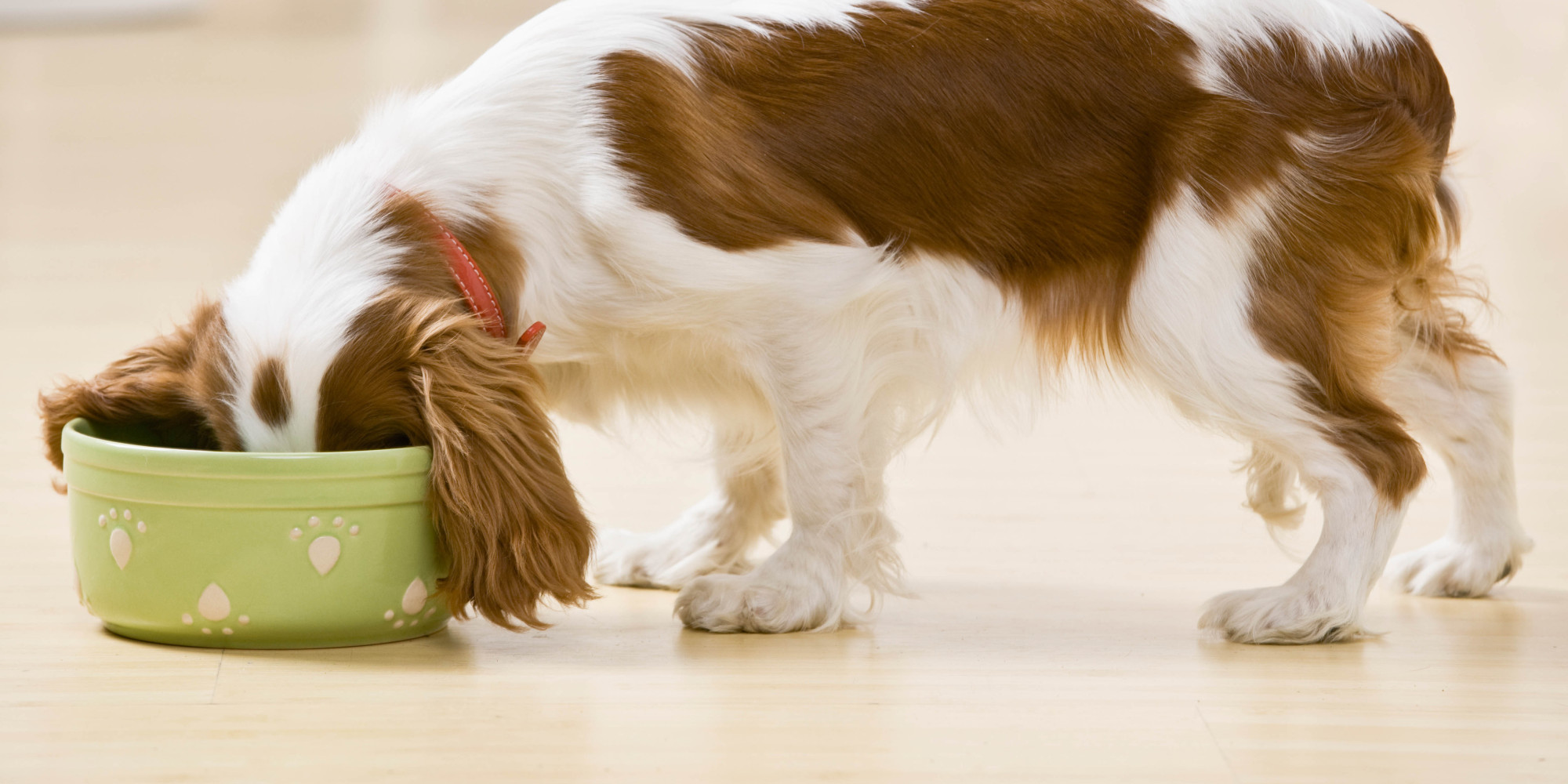
  • To avoid spilled food and water, teach your dog to sit before you put his food bowl on the floor. Deep-chested and large dogs should have their food and water bowls placed just under neck height.
  • Feeding time should be an approximate, not a precise, time. If you always feed him at 6:13, should 6:15 come around, you will have one frantic dog! You should rule the schedule, not him.
  • Never free feed. Many dogs will overeat if food is constantly available. They also may be more finicky about their food because they are never really hungry at mealtime. Let his gastric juices and digestive system take a rest in between meals.
  • Allow 15-20 minutes for your dog to eat his meal and remove any leftover food.
  • Keep children and other pets away from your dog while he is eating.
  • Don’t tease your dog by pretending to take the food dish away. If you are consistent and firm with him in all aspects of life, he will respect your authority. There is no need to exert your power over his food; he knows who feeds him anyway!
  • Always make sure his food is fresh and his bowls are washed with soap and water. Dogs will eat canned food even if it has gone bad.
  • Add a little hot water to canned food when you remove it from the refrigerator. Top dry food with a little canned food, unsalted meat or chicken broth for extra palatability.