Showing posts with label feeding tips. Show all posts

Sunday, October 18, 2015

How to Fit a Gentle Leader® Headcollar


One of the most common issues we hear about with the Gentle Leader is dogs don’t like to wear it. They paw at it, rub their snouts along the ground and can’t wait to get it off. This can be a huge problem if your dog is a puller and you need the help a Gentle Leader can provide. Taking time to get your dog comfortable with the headcollar is really the first step in fitting it correctly.

Get Your Dog Used to the Headcollar

The first tip in acclimating your pup to wearing the Gentle Leader is to take it slow. Your dog has probably been pulling you down the street for quite some time, so will a few extra days really make a difference?

Get out your Gentle Leader Headcollar and some very small yummy treats, like bits of romano cheese, hotdogs, or peanut butter on a spoon.

Hold the nose loop open and invite your dog to place his snout through the loop.
When your dog puts his nose even partially in the loop say yes and give him a treat. No pressure, just let him choose.

If he doesn’t, just remove the Gentle Leader Headcollar for a few seconds and try again.

You may simply try getting the dog to just touch the Gentle Leader at first. Remember, you're not in a hurry.

Practice this once or twice a day just before dinner so your dog is hungry.

Once your dog is happily putting his nose into the loop, you can begin fastening the neck strap and letting him eat his dinner with the Gentle Leader on.

Take it off at the end of the meal. This will help your dog associate the Gentle Leader Headcollar with something they enjoy – dinner!

Repeat this for a few more days until your dog acts happy and excited to put on the Gentle Leader Headcollar for dinner.

Fit the Headcollar


Before you completely transition to using the Gentle Leader on a walk, you will want to make sure it is fit correctly.

The neck strap should be high and snug on your dog, just behind the ears.

It should be snug enough so it does not rotate. This will keep it from rubbing or chafing.

The nose loop should fit loose enough so the strap can slide down to the fleshy part of your dog’s nose but it won’t come off over the snout. Your dog should be able to open his mouth normally.

Adjust how big the nose loop is with the nose loop clamp. Be sure to close the nose loop clamp securely so your dog can’t sneak his nose out of the loop.

Attach your leash to the O-ring and head out for your walk!

Attach the Leash & Start Your Walk


When you have the fit of the Gentle Leader Headcollar correctly, the next very important part of this equation is how you handle the leash.

Hold the leash so your dog has enough slack to walk by your side but not enough to rush ahead.

When your dog pulls, redirect your dog’s attention back to you.

Once he is back in the Heel position, reward your dog with a treat and then continue walking.

You may have to redirect your dog a lot at first, but with some patience, consistency, and rewards, your dog will quickly learn how to walk nicely on the leash.

Remember, no tension plus a loose leash means you should reward your dog with a small treat and praise. Tension with a tight leash means you should gently redirect your dog back into Heel position beside you. With a correct fit and proper leash techniques, the Gentle Leader Headcollar will help you both enjoy walks together.

Source by:http://www.petsafe.net/learn/how-to-fit-a-gentle-leader-headcollar

Tuesday, October 13, 2015

Ten tech innovations for the pet of the future

From "AirBnb for pets" to doggie activity monitors, these apps and tech will help you outfit your pet with the latest gear.

By Heidi Flato

Anyone who uses social media knows that the popularity of "pet parenting" has exploded in the U.S. The ASPCA estimates that approximately 70 million dogs and 74 million cats live in U.S. households — and that's on the conservative side. Every week, developers and inventors are creating new apps and devices to help pet lovers find, care for, board and entertain their furry friends. Here's a roundup of some of the latest innovations for the pet of the future.

Find a Pet to Adopt

Promising to help you "find fluffy singles near you," BarkBuddy is an app that bills itself as "Tinder for dogs." The app lets you view adoptable rescue pups in your area and swipe to choose potential matches.

Keep Your Pet Healthy Without the Hassle

Bringing pets to the vet can be a huge source of stress for pet owners, so services like VetPronto are popping up to help alleviate the inconvenience with veterinary house calls you can book from an app. Currently available in the San Francisco area, VetPronto's house calls cost $150 and include a comprehensive exam and prescriptions, and, at just $50 for additional pets, can offer big savings if you have multiple four-legged pals. They're also available evenings and weekends, making life easier for working pet parents. BarkCare, which is currently in private beta, aims to offer a similar service in New York City.

Monitor Your Pet's Whereabouts and Activity

Whistle bills itself as the world's most popular GPS pet tracker. Just attach the Whistle device to your pet's collar, set a "safe zone" around your home in which you're comfortable with your pet roaming, and you can track its movements and get alerts if it wanders out of the safe zone. Whistle also works as an activity tracker, and monitors temperature to alert you to extreme weather conditions.

Find a Good Pet Sitter

DogVacay is like AirBnb, but for pet sitting. Just enter your zip code and a few parameters such as whether you want to board your pet in your home or in the sitter's place, and DogVacay promises to show you trusted pet sitters in your area. Holidog offers a similar service, and includes walking and pet check-in visits in addition to full boarding, while DoggyBnB works by using your social networks to help you find a trusted friend to cat or dog sit.

Keep Your Pet Entertained

The Wag app promises background-checked dog walkers in the Los Angeles, San Francisco and New York City areas. It also allows you to track your dog's walk in real time on a map on your phone, providing entertainment for you as well as your pet. Worthee offers a similar service in the Chicagoland area.

If your pets tend to get lonely while you're at work or out and about, you can check in on them and interact with PetCube. The streamlined $199 device lets you stream live video of your pet through an app on your phone, and a two-way audio feed lets you "converse" with your pet as well.

source by:http://www.verizonwireless.com/news/article/2015/10/10-tech-innovations-for-the-pet-of-the-future.html

Sunday, October 11, 2015

How to Use an Indoor/Outdoor Potty for Toilet Training


When people call me about training their new puppy, potty training is always at the top of the list. There are options - you can choose to train your puppy indoors, outdoors, or a combination of both. Regardless of your choice, the method to train him is the same, and your involvement is crucial, especially at the beginning.

*Take him where you want him to go when he has to go.

*When he goes in the right place, reward him          with praise and a treat.

*Watch him like a hawk or confine him at all          other times.

There are several products to choose from regarding potty training your puppy indoors, one of which is a puppy potty. There are 3 main types of puppy potties.

*Ones that have synthetic grass on top of a grate   with the urine draining into a containment area     underneath

*Ones that use litter

*Ones that use sod or grass
 
Puppy potties with synthetic grass are a great option for house training.

Reasons to Use a Puppy Potty for House Training


*It feels like real grass to your puppy's feet, which is important if you want to transition him to pottying outside because he develops a preference for a grassy surface and because the surface feels different than wood, carpet, tile, etc.
*If you spend time away from home (go to work every day) so you can't take your puppy out whenever he needs to go, he has a place to go indoors.
*You don't have to get up in the middle of the night to take him outside, which is especially helpful during inclement weather or if you live in a high-rise.
*It makes you feel better because he goes in one place. Your puppy has a specifically delineated toilet area inside your house rather than eliminating throughout your house.
*Many companies offer sprays to help attract your puppy to the potty, products to congeal the urine, deodorizing sprays, or replacement grass. These products not only help your puppy in the training but also help you in cleaning.

Reasons to Use a Puppy Potty Long-Term


*It's portable so you can easily move it from one area of your home to the other - for example, you can move it from your home office or kitchen to your TV area to your bedroom.

*Your pup may have been injured and can't walk long distances.

*It's good for smaller dogs who have a faster metabolism and tend to eliminate more frequently.

*It's an excellent choice if you live in a high-rise, are not home all day, have an erratic schedule, or have mobility or health issues.

*You can clean the indoor potties yourself, and most of them are easily cleaned.

*Since the urine drains or is absorbed, your dog doesn't track it on your floors.

*He doesn't have to hold it as long as he would if his toilet area were outside.

Remember that puppies develop muscle control and mental control every day and need repetition in order to learn where you want him to go. Take him to the potty when he has to go. When he does toilet there, tell him what a good dog he is as he is going and give him a treat in the potty area immediately after he finishes. Training your puppy where you want him to eliminate takes time, patience, and consistency, and it will pay off for both of you.

source by:http://www.petsafe.net/learn/how-to-use-an-indoor-outdoor-potty-for-toilet-training

Friday, October 9, 2015

Dog Food Guidelines


Can you find your dog’s ribs easily, or do you have to search for them? If you discover that you are not able to feel its ribs, you have an overweight dog. Just like people, a healthy diet, combined with exercise, gives a dog physical and mental well-being. Good nutrition also gives your dog the means to fight off infection and illness.
It is best to feed your dog a diet of premium dog food that contains high quality digestible protein, without meat by-products, indigestible fillers, dyes or chemical preservatives. Even though premium food may cost more, your dog will eat less, be more satisfied and you will be able to see the results – glossy coat, shiny eyes, smooth skin and alert expression – with your own eyes. Regardless of what you choose to feed, always read the food labels to check for the ingredients and be wary of the additives mentioned above.
The debate of dry dog food versus canned dog food has been going on for some time. It has been advocated for many years that dry food helps rid teeth of tartar; however, this is not true. Brushing, nylon bones and regular veterinary cleaning are the best ways to manage your dog’s oral health. What is true is that dry food is very convenient and economic. If you choose dry food, the premium brands provide high quality nutrition and are definitely worth the additional cost.
Canned food contains more moisture because it is manufactured from fresh meat; it is very digestible and contains no preservatives. Dogs almost always prefer canned food to dry food, but it can be expensive if you are feeding a large dog.


Some more feeding tips:

  • Listings on dog food cans and bags of dry food of “how much to feed the average adult dog” should be taken as basic guidelines that can vary widely according to activity level, size and metabolism of a dog.
  • Most adult dogs do best if fed twice daily. This avoids overextending the stomach. Divide the total ration into two equal portions. It is particularly important to feed smaller meals to deep-chested dogs that may have a tendency to develop bloat or stomach torsion.
  • Limit strenuous exercise or play before and after meals, especially for breeds prone to bloat.
  • Do not let breeds prone to bloat consume excessive amounts of water after eating.
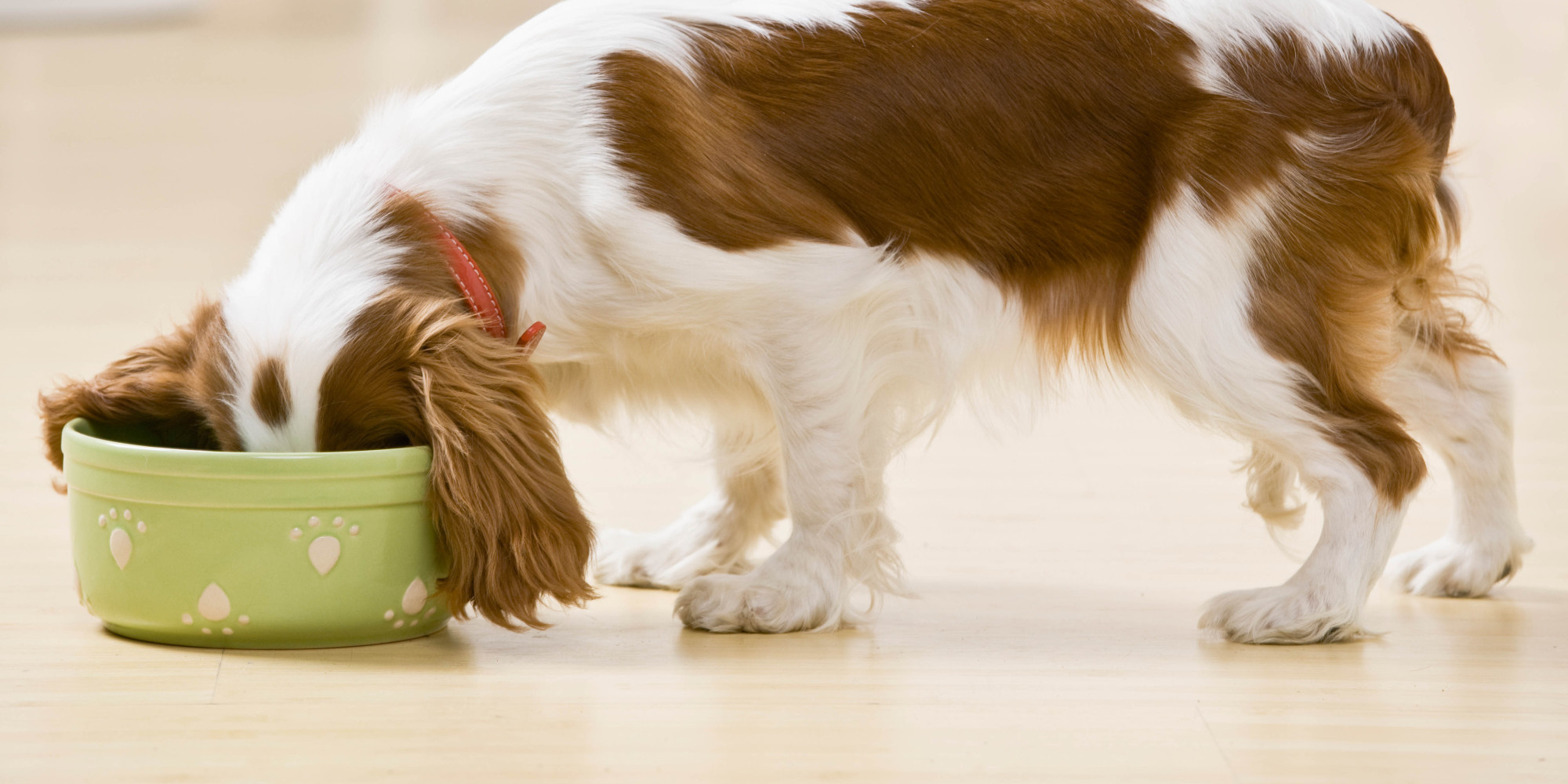
  • To avoid spilled food and water, teach your dog to sit before you put his food bowl on the floor. Deep-chested and large dogs should have their food and water bowls placed just under neck height.
  • Feeding time should be an approximate, not a precise, time. If you always feed him at 6:13, should 6:15 come around, you will have one frantic dog! You should rule the schedule, not him.
  • Never free feed. Many dogs will overeat if food is constantly available. They also may be more finicky about their food because they are never really hungry at mealtime. Let his gastric juices and digestive system take a rest in between meals.
  • Allow 15-20 minutes for your dog to eat his meal and remove any leftover food.
  • Keep children and other pets away from your dog while he is eating.
  • Don’t tease your dog by pretending to take the food dish away. If you are consistent and firm with him in all aspects of life, he will respect your authority. There is no need to exert your power over his food; he knows who feeds him anyway!
  • Always make sure his food is fresh and his bowls are washed with soap and water. Dogs will eat canned food even if it has gone bad.
  • Add a little hot water to canned food when you remove it from the refrigerator. Top dry food with a little canned food, unsalted meat or chicken broth for extra palatability.